
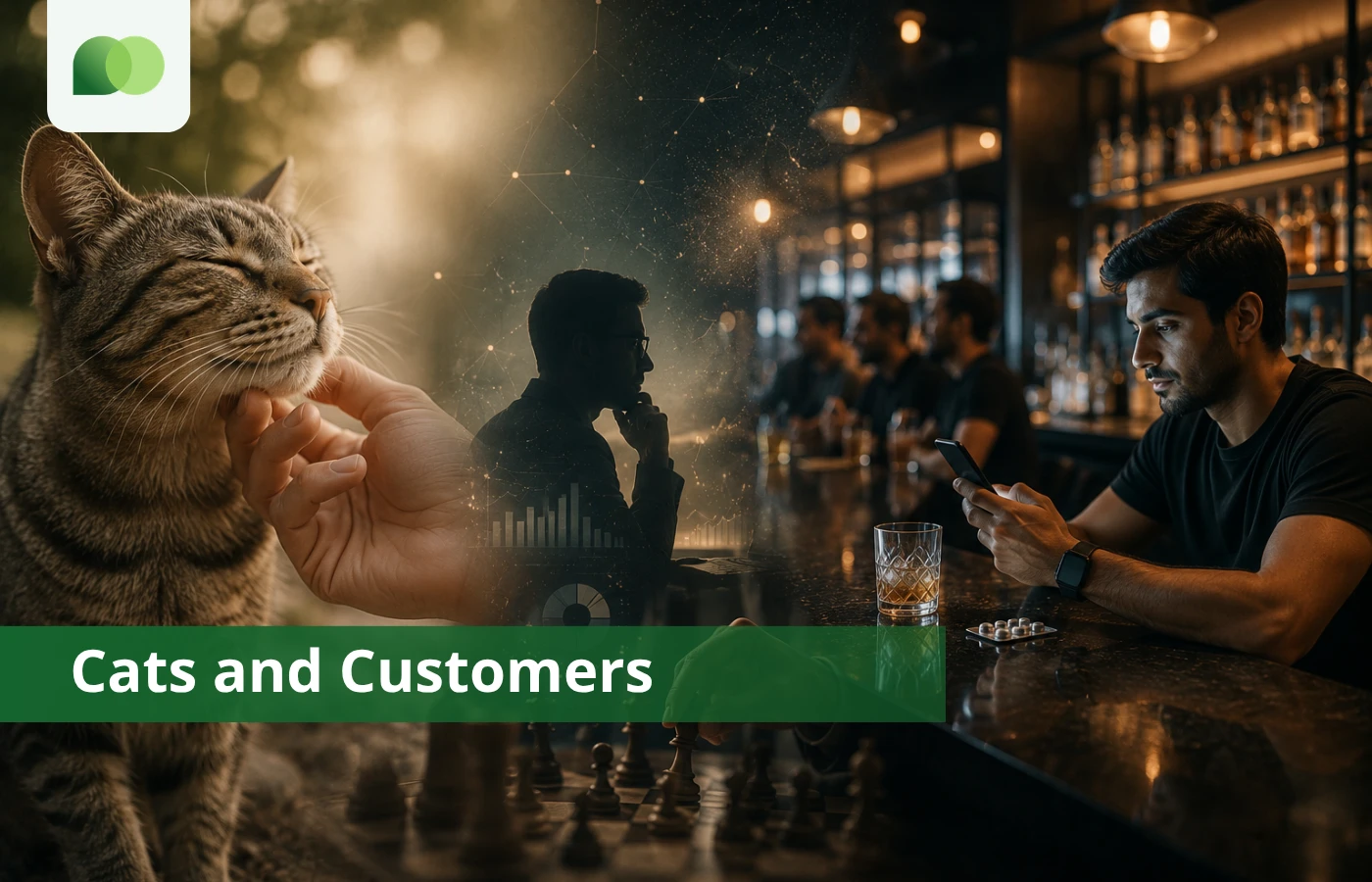
Cats and Customers
There is almost as much literature dedicated to divining the secret body language of cats as there is to understanding customer behaviour.
Undoubtedly, in either case one needs to unpack multiple layers and discard assumptions to land upon an ah-ha moment.
But there is also something as overthinking. Maybe both the customer and cat aren’t really so mysterious.
Try making eye contact with an adorable street cat, stroke it along its spine and cradle her in your arms. Both of you will enjoy a moment of bliss.
Not that the customer is a cat, though in some cases, the reverse is true. But the same commonsense principle applies.
You have an intuition about why sales are down this quarter, when no logical explanation can fully account for it. There is only one way to go.
Meet the customer. Directly. Not to motivate them to buy. But to observe and listen.
No Buzz in Booze Sales
Here is a hypothetical case study
A liquor company runs a very compelling campaign for party drink premixes in an affluent micro market of Mumbai. Since direct advertising isn’t possible, they have tied with 10 bars to correlate promotional spends with ROI. The product holds promise.
The pre-sale focus group loved the taste. The price was just right. The packaging was striking.
But sales just never picked up.
All desktop analysis and big data yielded inclusive results.
Until a young sales guy hung around at one of the bars and spoke to an athletic 26-year-old tech bro wearing a smart watch.
Our man offered a free drink. The prospective customer enjoyed it. But kept it away after a few sips.
He was polite but was keen to continue watching an OTT series on his phone. He laughed intermittently. And at one point, he reached into his pocket, popped a lozenge strip and drifted off. The young man left after saying a perfunctory bye.
The sales guy was not disappointed. He had been attentive. Drinking was no more social or a habit. The web series was enough of an addiction. The prescription THC lozenge offered more buzz for next to no calories as the smart watch would testify.
The bar was just a place to chill. Not necessarily to drink. The grammar of enjoying leisure had changed for this market. Alcohol was no longer integral to it.
Shifting Goalposts
The liquor company had made no mistake. The market comprising 20-somethings who grew up with the pandemic was not big on alcohol.
So, our company may either decide to target a different demographic or perhaps buy out a craft beer company.
Product quality, marketing, communication and hard sell is all good and necessary. But what is important is to never lose sight of the goalpost, which unlike in the ongoing World Cup has a nasty habit of shifting without warning.
The only insurance is a good regimen – Listen | Imagine | Focus | Deliver